Crochet curling is almost always a tension problem. Here are the 7 most common causes, how to tell which one you have, and how to fix each one.
If your crochet is curling, it's almost always a tension problem: your starting chain is tighter than the rows you work into it, or your stitches are pulling tighter on one side. The good news is that every cause has a simple fix, and most of them cost nothing. Below are the seven most common reasons crochet curls, how to tell which one you have, and exactly what to do about it.
Total cost of the fixes: $0–$6. Most fixes are technique changes. The only thing you might buy is a crochet hook one or two sizes larger (about $2–$6) for your foundation chain.
First, figure out which way it curls
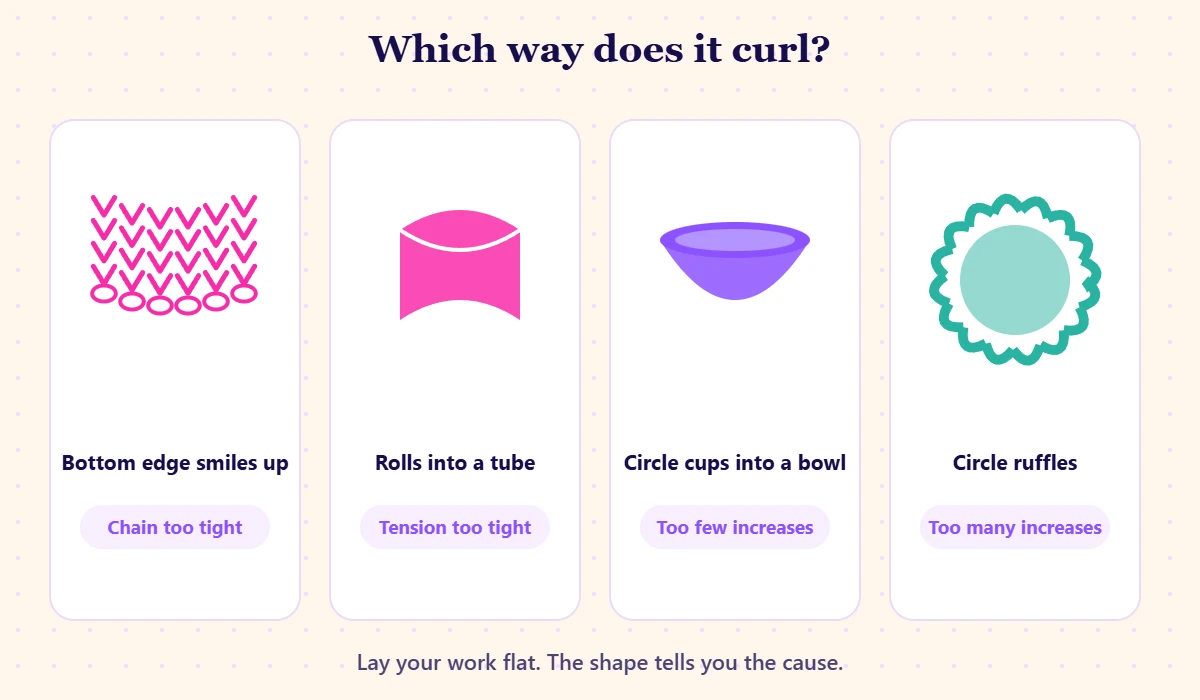
Lay your work flat on a table and look at it for a minute. The direction of the curl tells you where the problem is:
- The bottom edge curls up (a "smile" shape): your foundation chain is too tight compared with the rows above it.
- The whole piece rolls into a tube: your stitches are tight overall, or you're working in only one loop.
- A circle cups into a bowl: you're not adding enough increases in each round.
- A circle ruffles like a wave: you're adding too many increases.
- The sides slant or lean: your stitch count is changing from row to row.
7 reasons your crochet is curling (and how to fix each one)
1. Your foundation chain is too tight
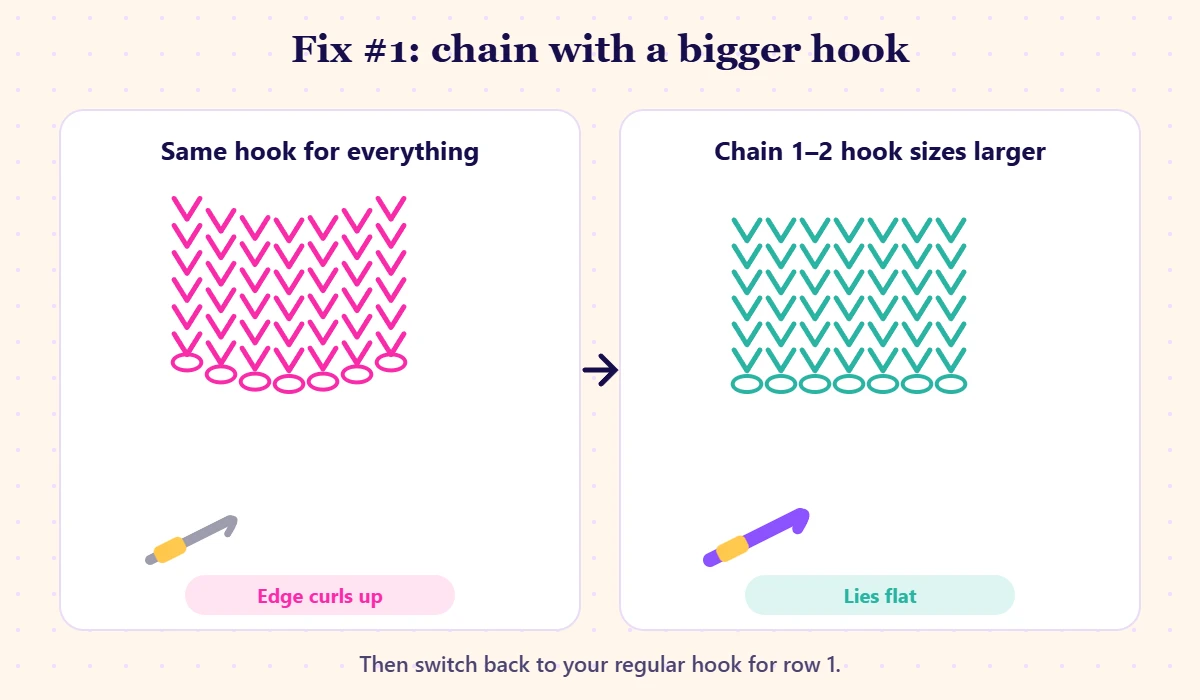
This is the number one cause, especially for beginners. Most people chain more tightly than they stitch, so the first row is shorter than every row after it and the bottom edge pulls up into a curve.
Fix: make your starting chain with a hook one or two sizes larger than the pattern calls for, then switch back to the regular hook for row 1. If you only have one hook, consciously loosen up and pull each chain loop a little taller.
2. You're working into the wrong part of the chain
Working into the back bump of the chain (or into just one loop) changes how the first row sits. That's not wrong, but it can make the edge tighter.
Fix: try working into the top two loops of the chain for a looser first row, or use a foundation stitch (foundation single crochet or foundation double crochet), which builds the chain and first row at the same time with the same tension.
3. Your overall tension is very tight
If the entire piece feels stiff and wants to roll, you may be gripping the yarn too hard. Tight stitches have nowhere to go, so the fabric curves.
Fix: go up a hook size, relax your yarn hand, and make sure each loop slides onto the widest part of the hook shaft, not the narrow throat near the tip.
4. You're adding or losing stitches
Accidentally skipping the first or last stitch of a row (or working twice into one) makes the edges slant and the fabric warp.
Fix: count your stitches at the end of each row for the first few rows, and put a stitch marker in the first and last stitch so you can't miss them.
5. You're working in only one loop
Back-loop-only and front-loop-only stitches create ridges, and a piece worked entirely in one loop on the same side can roll.
Fix: unless your pattern asks for it, work under both loops of each stitch.
6. Your circle has the wrong number of increases
Flat circles need a steady number of increases per round: usually 6 for single crochet, 8 for half double crochet and 12 for double crochet. Too few and it cups; too many and it ruffles.
Fix: follow the increase pattern exactly (for single crochet: 6, 12, 18, 24 stitches and so on) and stagger where you place increases so the circle doesn't turn into a hexagon. Starting with a magic ring also helps the center lie flat.
7. Your yarn and hook don't match
Using a small hook with thick yarn makes dense, stiff fabric that is prone to curling. Some yarns, like tightly twisted cotton, are also less forgiving than soft acrylic.
Fix: check the yarn label for the recommended hook size and start there.
How to fix a piece that's already finished
If you've already finished a scarf or blanket and the edges curl, you don't have to start over:
- Block it. Wet the piece (or spritz it), pin it flat to a foam mat or folded towel in the shape you want, and let it dry completely. This works best on natural fibers; for acrylic, gentle steam blocking from a distance works.
- Add a border. A round or two of single crochet worked evenly around all four sides helps square things up and adds weight to the edges.
- Take out row 1 only if needed. For a very tight chain, some crocheters cut the chain off and re-work a looser edge in the other direction. Try blocking first.
Quick prevention checklist
- Chain with a hook 1–2 sizes larger.
- Count stitches every row until it becomes a habit.
- Use stitch markers in the first and last stitches.
- Match your hook to the yarn label.
- Make a small swatch (10–15 rows) before starting a big project.
Want to practice even tension on something small? Browse more beginner guides in Crochet Stitches & Techniques or start with an easy project from Crochet Patterns.
FAQ
Will blocking stop crochet from curling?
Blocking flattens most mild curling, especially on wool and cotton. If the curl comes from a much tighter starting chain, blocking helps but the curl may slowly return, so fix the chain on your next project.
Why does my single crochet curl but double crochet doesn't?
Single crochet is a short, dense stitch, so any difference between your chain and your stitches shows up more. Taller stitches like double crochet are more flexible and hide small tension differences.
Does crochet curl less as it gets bigger?
Sometimes. The weight of a larger piece can pull a slight curl flat, but if the cause is a tight chain or changing stitch counts, it won't fix itself.
Can I fix curling without blocking?
Yes. Adding a simple single crochet border around the edge is often enough to stop small curls, and it makes the piece look more finished.