Needlepoint is relaxing, forgiving and trending. Here's what to buy, the two stitches you need and an easy first ornament project for about $20–$30.
Needlepoint is stitching with yarn or thread on a stiff, open-weave canvas until every hole is covered and the whole design is filled in. It's slower and more relaxing than embroidery, it's very forgiving for beginners, and it's having a big moment: Michaels' 2026 Creativity Trend Report found needlepoint searches up 251% year over year. Here's everything you need to start, the two stitches you actually need, and an easy first project.
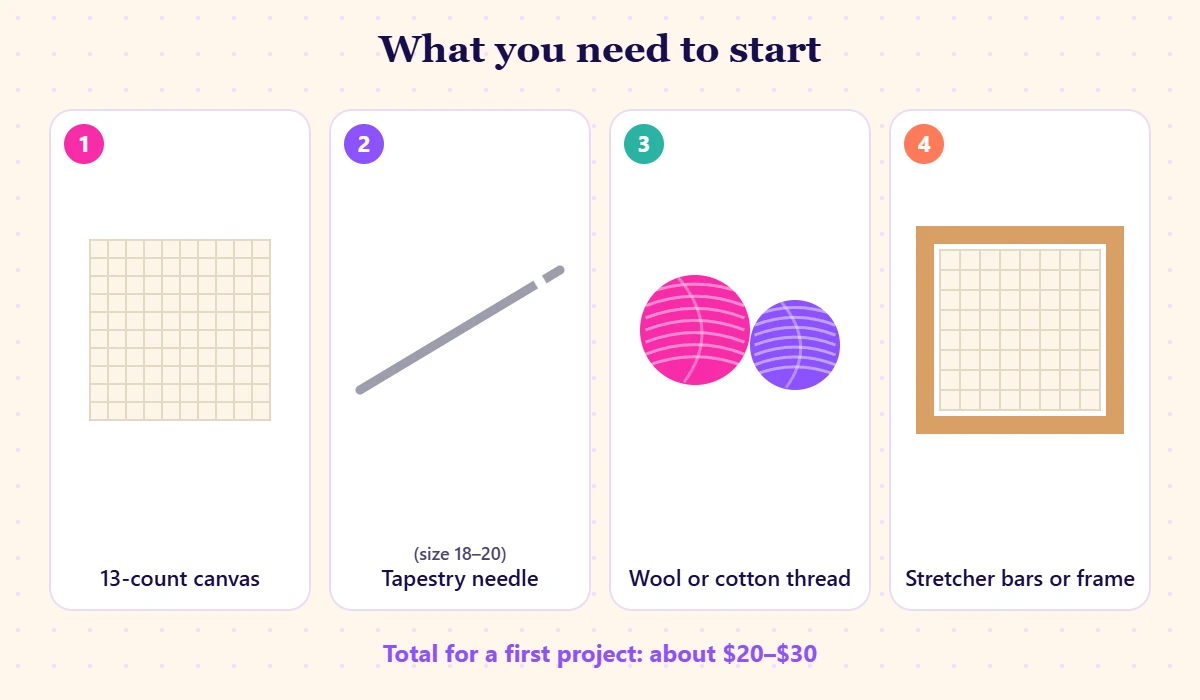
Total cost for a first project: about $20–$30. A small printed or painted canvas or a 6x6-inch piece of 13-count mono canvas (about $5–$12), a pack of size 20 tapestry needles (about $2–$3), wool or cotton needlepoint thread (about $8–$12) and a set of stretcher bars or a needlepoint frame (about $6–$10). A beginner kit with canvas, thread and needle often lands in the same range.
Needlepoint vs embroidery vs cross stitch
| Needlepoint | Cross stitch | Embroidery | |
|---|---|---|---|
| Base | Stiff canvas with open holes | Aida cloth in a grid | Any fabric |
| Coverage | Whole canvas is covered | Background often left bare | Only the design |
| Stitch | Mostly half-cross (tent) stitch | Full X stitches | Dozens of free stitches |
| Best for | Ornaments, pillows, keyfobs, belts | Pictures and samplers | Hoop art, clothing, lettering |
If you've already tried basic embroidery stitches, needlepoint will feel familiar but more structured: you always go in and out of the canvas holes, so your stitches stay even almost automatically.
Supplies you need
Canvas
Canvas is sold by mesh count, the number of holes per inch. For a first project, 13-count is ideal: the holes are easy to see, and the project grows fast. 18-count is finer and more detailed but slower. You can buy a painted canvas (the design is printed or hand-painted on, and you just stitch over the colors), a charted design that you follow from a grid, or plain canvas to stitch your own simple pattern.
Thread
Wool needlepoint yarn (such as Persian or tapestry wool) is traditional and covers the canvas well. Cotton thread and stranded floss also work; on 13-count canvas, use about 12 strands of floss (two full 6-strand lengths together) so the canvas doesn't peek through.
Needle
A blunt tapestry needle: size 18–20 for 13-count canvas, size 22 for 18-count. Blunt tips slip through the holes without splitting the canvas threads.
Frame
Stretcher bars or a scroll frame keep the canvas taut so your stitches stay even and the canvas doesn't warp. You can stitch small pieces in hand, but expect to block them afterward.
The two stitches you need
Continental stitch (tent stitch)
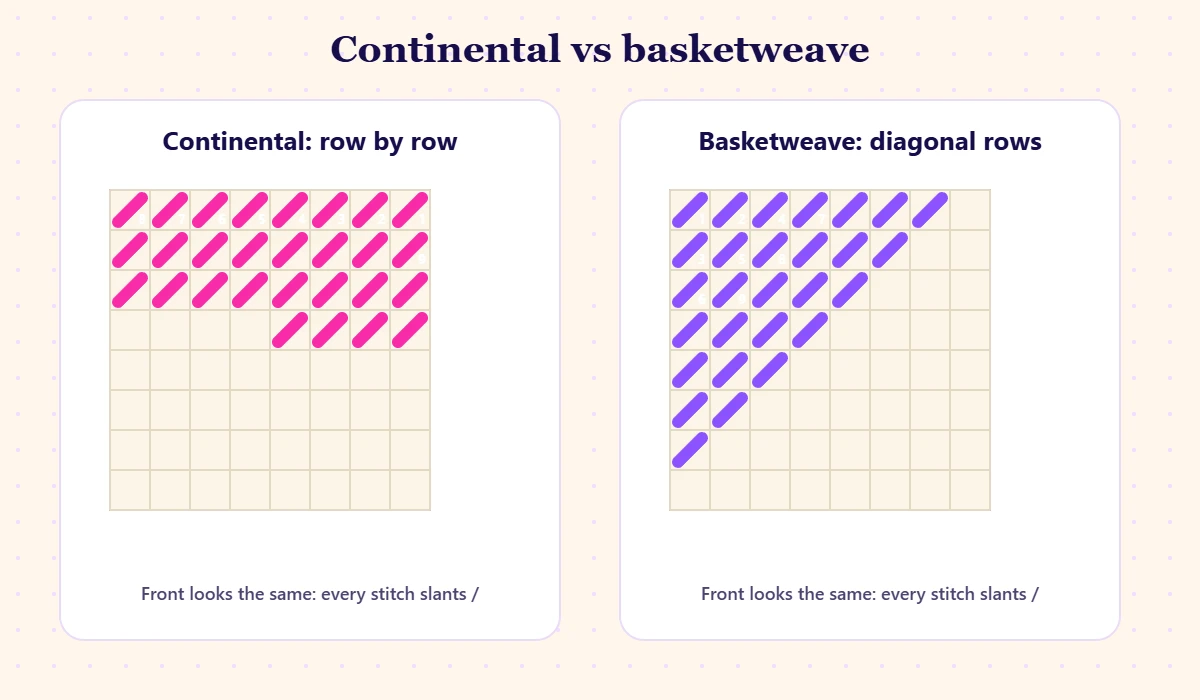
A small diagonal stitch over one intersection of the canvas, all slanting the same direction (bottom left to top right on the front). Work in rows from right to left: come up in the hole at the bottom left of the stitch, go down one hole up and one to the right, then come up again in the next hole to the left. It's the best stitch for outlines, single rows and small areas.
Basketweave stitch
It looks exactly like continental stitch on the front, but you work it in diagonal rows, which creates a woven pattern on the back. Basketweave uses a little more thread, but it doesn't pull the canvas out of shape, so it's the go-to stitch for backgrounds and large areas.
The golden rule: every stitch on the front slants the same way. If one stitch slants the other direction, it will stand out.
How to start and finish a thread
- Start with a waste knot. Tie a knot at the end of your thread, take the needle down from the front about an inch away from where you'll stitch, in the path of your first row. Your first stitches will cover the tail on the back. Once covered, snip the knot off.
- Stitch with 18-inch lengths. Longer thread wears thin as it passes through the canvas.
- Finish by weaving. On the back, run the needle under about an inch of existing stitches, then trim. No knots needed.
Your first project: a needlepoint ornament
- Choose a small design, about 3x3 to 4x4 inches, with big blocks of color, such as a heart, star or simple initial.
- Tape the edges of the canvas with masking tape so the threads don't snag your yarn.
- Mount the canvas on stretcher bars with thumbtacks.
- Stitch the design areas in continental stitch first, then fill the background in basketweave.
- When every hole is covered, take it off the frame. Trim leaving half an inch of bare canvas, fold the edges back, and back it with felt glued or whip-stitched in place. Add a ribbon loop for hanging.
Beginner mistakes to avoid
- Pulling too tight. Tension that's too firm distorts the canvas. Let the stitch lie on the surface.
- Thread twisting. Let the needle dangle every few stitches so the thread untwists, which gives fuller coverage.
- Carrying thread across the back. Jumping more than an inch or two behind bare canvas shows through. End and restart instead.
- Using the wrong needle size. A needle that's too big stretches the holes; too small and it's hard to pull through.
Find more patterns and tips in Needlepoint and the rest of Embroidery & Needlepoint.
FAQ
Is needlepoint hard for beginners?
No. Needlepoint is one of the easiest needle crafts to learn because the canvas holes guide every stitch. Most beginners can do continental stitch within a few minutes.
What size canvas should a beginner use?
Start with 13-count canvas. The holes are big enough to see easily and a small ornament takes a few evenings, not weeks.
Can I use embroidery floss for needlepoint?
Yes. Use enough strands to cover the canvas fully: about 12 strands on 13-count canvas and 8–9 strands on 18-count.
Do I need a frame for needlepoint?
It's strongly recommended. A frame keeps the canvas square and your tension even. Small pieces can be stitched in hand and blocked afterward.